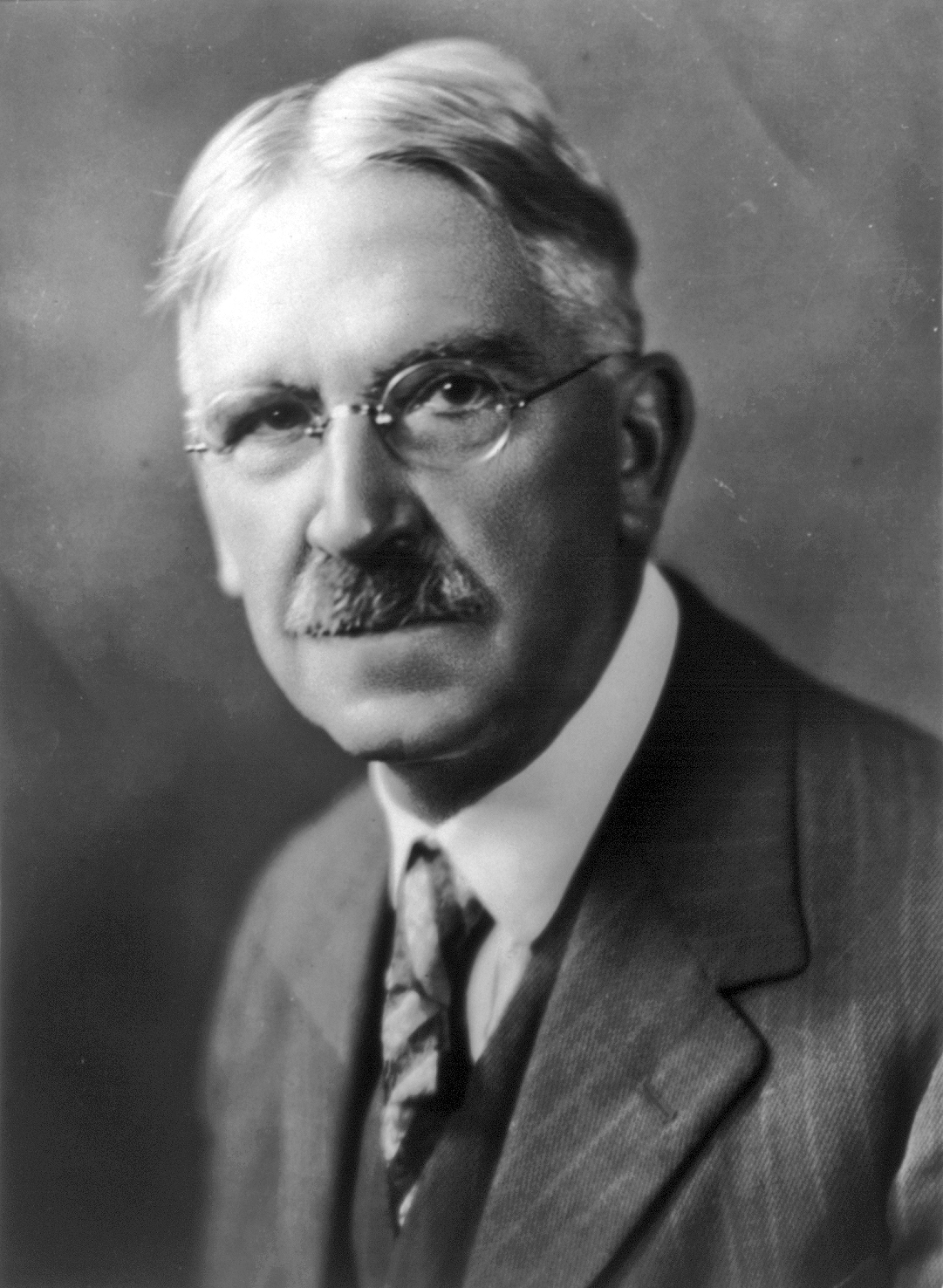
Philosopher, psychologist, and educational reformer John Dewey was one of America’s most influential scholars. In 1896, he published a foundational critique that challenged the prevailing trend of breaking human thought and behavior into isolated, mechanical parts. By reframing the “reflex arc” into a continuous, adaptive circle, Dewey helped launch American functionalism—shifting psychology’s focus away from cold structural analysis and toward how living beings actively learn, adapt, and make sense of their world.
early life & education
John Dewey was born on October 20, 1859, in Burlington, Vermont, to Archibald Sprague Dewey, a merchant and Union Army veteran, and Lucina Artemisia Rich Dewey, whose devout evangelical faith and commitment to social reform deeply influenced her son’s lifelong interest in civic life and ethics.
Raised in a modest, rural New England environment, Dewey attended public schools in Burlington before earning his bachelor’s degree in philosophy from the University of Vermont in 1879. Prior to entering academia, he spent two years teaching high school in Oil City, Pennsylvania, followed by a short stint teaching at an elementary school in Charlotte, Vermont.
Driven by a desire to deepen his philosophical work, he pursued graduate studies at Johns Hopkins University, earning his Ph.D. in 1884. He then launched his professional career as a professor of philosophy and psychology at the University of Michigan and the University of Minnesota, building the academic foundation that would later catapult him to international prominence at the University of Chicago and Columbia University.
the birth of functionalism
John Dewey (1859–1952), a co-founder of the influential Chicago School of psychology at the University of Chicago, reshaped the landscape of early psychological thought with a single, groundbreaking paper. Published in 1896 in Psychological Review, “The Reflex Arc Concept in Psychology” served as a watershed moment—establishing a clear dividing line between the rigid structuralism of the late 19th century and the emergent, living dynamic of functionalism.
At its core, structuralism sought to dissect the mind into fundamental elements, much like a chemist analyzes compound molecules. Dewey recognized that when human behavior is stripped down to disconnected, mechanical components, its essential meaning is lost.
“A genuine purpose always starts with an impulse. Obstruction of the immediate execution of an impulse converts it into a desire.
JOHN DEWEY, Experience and Education
Nevertheless neither impulse nor desire is itself a purpose.
A purpose is an end-view. That is, it involves foresight of the consequences which will result from acting upon impulse.”
from broken arc to living circle
Before Dewey’s intervention, traditional accounts of the “reflex arc” treated behavior as a linear sequence with a clear beginning and end:
Stimulus ➡ Response
In this classic linear model:
- A stimulus occurs at one end of the arc.
- A physical response occurs at the other end.
- The behavioral unit terminates once the response is delivered.
Dewey challenged this reductionist view, demonstrating that human behavior does not occur in a vacuum of isolated arcs. Instead, behavior functions as a continuous, completed circle.
the child and the flame
Consider a young child stepping near the heat of a floor furnace:
- The Initial Stimulus: The child encounters the heat.
- The Response: The child instinctively pulls her foot back.
- The Altered Perception: The act of pulling away is not merely an endpoint—it fundamentally alters how the child perceives the furnace moving forward.
- The Adaptive Loop: The next time the child encounters the heat, the perception is transformed; she actively avoids it.
Dewey insisted that stimulus, response, and altered perception form a single, organic unit of behavior. Attempting to chop this loop into smaller, artificial laboratory constructs strips the act of its vital context and purpose.
the functioning organism in its world
Dewey’s paper re-anchored psychology in the reality of living organisms. Rather than viewing human beings as passive receivers of external inputs, he argued that psychology’s proper subject matter is the whole organism actively adapting to its environment.
| Structuralist Reductionism | Dewey’s Functional Synthesis |
| Focus: Isolated elements & sensory components | Focus: Integrated, living units of action |
| Model: Linear & mechanical (Reflex Arc) | Model: Circular, feedback-driven (Reflex Circle) |
| Aim: Dissection of consciousness | Aim: Practical adaptation & environmental fit |
By viewing action through the lens of adaptation, Dewey gave functionalism a higher ethical and practical purpose: helping human beings navigate, learn from, and meaningfully inhabit their environments.
learning as growth
Dewey’s work offered a powerful rebuttal to the psychologist’s fallacy—the error of assuming that the subject experiences a psychological event in the exact, compartmentalized way the analyzing scientist categorizes it.
By demonstrating that organisms learn from consequences, Dewey proved that humans are not static automatons bound to repeat fixed reactions.
- The same stimulus does not produce the exact same response every time.
- Experience rewires perception.
- Memory transforms future action.
What “The Reflex Arc Concept in Psychology” ultimately taught us is that human behavior is an ongoing conversation between the inner life and the world—a continuous loop of experience, reflection, and growth.
Among those organisms who learn from consequences are children, of course. As a result of Dewey’s scientific observations, he became a pioneer and proponent of hands-on learning, also known as experiential education. His philosophies and publications continued to inform educators and parents alike, even contributing to the modern home education movement of the 1970s and beyond.
“Education is not preparation for life;
john dewey
education is life itself.”
endnotes
Dewey, John. “Psychology and Social Practice.” Psychological Review, vol. 7, no. 2, Mar. 1900, pp. 105-24, APA PsycNet, doi.org.
Dewey, John. The School and Society. University of Chicago Press, 1889.
Moore, Philip B. John Dewey: Prophet of an Educated Democracy. Routledge, 2025.
more from the third eve
- The Architecture of the Mind: The Evolution of Psychology
- James McKeen Cattell
- William James
- Sir Francis Galton
- John Dewey ◀ You are here.

Leave a Reply