
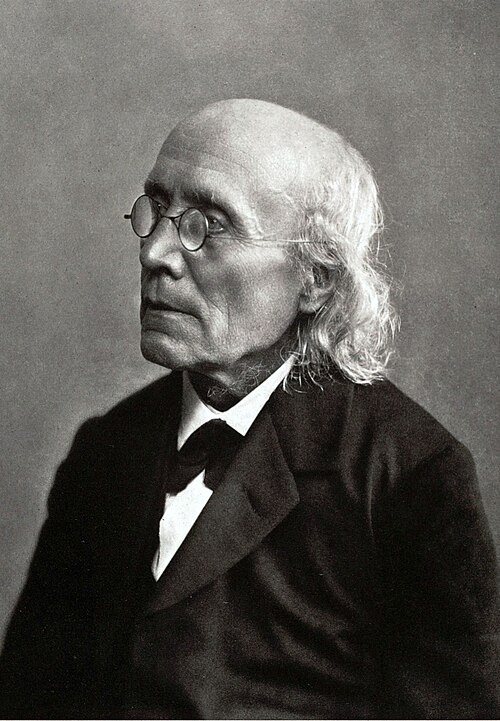
Gustav Theodor Fechner (1801-1887) stands as one of the most intriguing and pivotal figures in the history of science. Trained in medicine and physics, Fechner bridged the gap between philosophy and biology, ultimately laying the empirical foundation for modern experimental psychology through the creation of psychophysics.
brilliance, breakdown, and breakthrough
Born in southeastern Germany to a village minister, Fechner entered the University of Leipzig in 1817. There, he studied medicine and attended physiology lectures by Ernst Heinrich Weber—a relationship that would later shape his life’s work.
After completing his medical studies, Fechner pivoted to physics and mathematics, translating over a dozen French handbooks on physics and chemistry into German. By 1824, he was lecturing in physics at Leipzig and conducting pioneering research on sensory systems. However, his early work came with a heavy cost: while studying visual afterimages by staring directly at the sun through colored glasses, he severely damaged his eyes.
In 1833, Fechner was awarded a full professorship at Leipzig, but shortly thereafter plunged into a severe, multi-year depression. He spent years isolated in a pitch-black room, eating little, suffering intense anxiety, and relying on his mother to read to him through a small opening in the door.
His recovery was as eccentric as his illness:
- The Curative Diet: A friend dreamed of feeding Fechner raw spiced ham marinated in Rhine wine and lemon juice; upon trying the dish, it became a staple of his diet.
- The Dream of 77: Fechner dreamed of the number 77, interpreting it to mean he would recover in 77 days. When his health indeed restored on schedule, his deep depression shifted into a state of intense euphoria.
Believing he was divinely chosen to solve the riddles of the universe, Fechner developed his theory of the pleasure principle—a concept that would heavily influence Sigmund Freud decades later. Although he retired as an invalid in 1844, Fechner remained intellectually active, contributing scholarly work every year for the next 43 years until his death in 1887 at age 86.
“The material world is the outer, visible side of the universe; the spiritual world is its inner, invisible side … Mind and body are two ways of experiencing the same thing.”
Gustav Fechner, The Daylight View vs. The Night View (1879)
bridging mind and body
Fechner’s paramount contribution was crossing the barrier between the mental and material worlds by connecting them empirically. He coined the term psychophysics to describe the quantitative study of the relationship between psychological sensations (mind) and physical stimuli (body).
While measuring physical stimulus intensity was straightforward, quantifying internal subjective sensation was a major hurdle. Fechner solved this by introducing two key sensory boundaries:
Stimulus Threshold (Absolute Threshold): The minimum point of stimulus intensity required for a sensation to be detected. Below this point, no sensation is reported.
Differential Threshold (Just Noticeable Difference): The minimum amount of change in physical stimulus required to produce a detectable change in mental sensation.
fechner’s law
Fechner recognized that sensory perception does not increase at a linear 1:1 ratio with physical energy. Instead, mental sensation grows arithmetically, while physical stimulation increases geometrically—a logarithmic relationship expressed mathematically as:
S = K log R
- S = Magnitude of the mental sensation
- K = A domain-specific constant
- R = Magnitude of the physical stimulus (Reiz)
the three psychophysical methods
To measure these sensory boundaries with scientific rigor, Fechner systematized three core experimental techniques that remain fundamental to psychological research today:
| Method | Historical Origin | Modern Application |
| Method of Average Error | Developed with A. W. Volkmann | Subjects adjust a variable stimulus until it matches a standard. Essential for calculating mean values in visual/auditory discrimination and optical illusions. |
| Method of Constant Stimuli | Adapted from Karl von Vierordt | Measures stimulus differences required to yield consistent proportion judgments using fixed stimulus pairs. Used to pinpoint precise sensory thresholds. |
| Method of Limits | Formalized by Delezenne (1827) & Weber | Stimuli are presented in ascending or descending order to identify the exact point where perception changes. |
legacy & lasting impact
In 1860, Fechner published his masterwork, Elemente der Psychophysik (Elements of Psychophysics), laying out a unified model for measuring internal subjective experience.
Fechner’s work proved that mental processes could be quantified and measured with mathematical precision, directly inspiring Wilhelm Wundt to establish the world’s first formal experimental psychology laboratory in Leipzig in 1879. Today, Fechner’s methods underpin diverse fields ranging from clinical audiology and neuroscience to user experience design and psychophysics.
“Man lives on earth not once, but three times:
gustav fechner, the little book of life after death (1836)
the first stage of his life is his continual sleep;
the second, sleeping and waking by turns;
the third, waking forever.”
endnotes
Fechner, Gustav Theodor. The Day View Opposite the Night View. Breitkopf & Hartel, 1919.
Fechner, Gustav Theodor. The Little Book of Life After Death. Little, Brown, and Co., 1836.
more from the third eve
- The Architecture of the Mind: The Evolution of Psychology.
- René Descartes, Part 1
- René Descartes, Part 2
- James McKeen Cattell
- William James
- Hermann Helmholtz
- Gustav Fechner ◀ You are here.

Leave a Reply