the call to serve
The bishop, priest, or deacon are the Ordinary Ministers of Holy Communion in the Catholic Church; but when the church congregation grows in size to the point that communion will be unduly prolonged with only the priest and deacon serving, the archbishop may appoint lay people to help serve it. Sometimes an Extraordinary Minister of Holy Communion is also asked to take communion to someone who is homebound, hospitalized, or even in prison; but in general we serve only in church and during mass.
When I received the letter from our archbishop informing me of the appointment, I felt both honored and deeply humbled. The Church teaches that those who serve in this capacity should live in a way that honors the name of Christ. I have to admit: when I was called, I trembled. I know my own unworthiness too well. Who am I to take the cup or the bread into my hands—for anyone, even myself? What does it mean to live an “exemplary life”? How strange, unsettling, and humbling that those who have seen me at my weakest—my fellow parishioners, my priest, the one who hears my confessions—believe I am fit to serve at the Lord’s table.
For a long time, I trembled inwardly every time I thought of the appointment.
preparation
I fast on the afternoons before I serve as an Extraordinary Minister of Holy Communion. All the faithful are called to fast for at least an hour before receiving the Eucharist, to prepare themselves spiritually. I fast all afternoon. I need all the grace I can get.
As the hour draws near, I begin to shake a little inside. I think of the patriarchs who removed their shoes before entering the Holy of Holies. I remember those who were struck dead for touching what was sacred. I picture Aaron and his sons, tending the sanctuary lamp day and night—just as the sanctuary lamp still burns, unceasing, in every Catholic church. The weight of ancient tradition settles on my shoulders like a hair shirt. I feel my uncleanness. I ask myself when I last went to confession—when I last confessed my sins to God in private. I rewind the inner tapes of the past week and find no shortage of failings. I tremble all the more.
gathering in the chapel
At 5:00 p.m., I go to the church and step into the chapel. Near the door, twelve silver cross medallions hang from a wooden board. These mark us as Extraordinary Ministers. I take one and slip it over my head, feeling the weight of the cross rest on my chest.
There are five people already in the chapel. I recognize two of them. We don’t speak or even look at one another; they’re already on their knees, heads bowed in prayer.
The sun beats in.
the ancient pulse
I feel nervous and fidgety, uncomfortable in the wooden chair. Self-conscious, I shift around, fussing as I try to find the little book for this month’s Liturgy of the Hours—those ancient prayers of Psalms and Gospel, prayed around the clock by Catholic and Orthodox Christians across the world. Prayers rising like incense before God, as Revelation says.
I kneel.
I feel the ancient pulse.
The ground remembers me.
The smallness of the chapel is a welcome. It is eternally quiet; no one seems to breathe. The sun hangs low, and the wine in the chalice on the small altar glows with a fabulous fire. I can’t take my eyes off it. Once, I looked into a flawless ruby through a jeweler’s scope—a rare stone, owned by a man I know who works with gems and feels called to shape beauty from them. That ruby, worth a hundred thousand dollars, glowed pink-red like blood mingled with water.
The wine is like that exquisite gem—beautiful, stunning, irresistible.
I slide deeper into Spirit, perceiving great depth, and height. The roof and the floor disappear. I am suspended in space and time.
A kneeler creaks nearby, bringing me gently back to earth. It comforts me—my brothers and sisters are near. As other Extraordinary Ministers arrive, the air shifts, charged now with quiet anticipation. The Sacristan enters and moves a ciborium here, a chalice there. The wine—and my heart—are radiant.
Then come the priest, the deacon, the acolytes, in a soft whoosh of albs, cassocks, surplices, and stoles. Father leads us in the Liturgy of the Hours, and the chapel fills with Scripture: a verse from one side, a response from the other. A verse, a response. Call and answer, until the Word of God is proclaimed and we all say:
Amen.
AMEN.
We are ready.
procession and holy water
Father raises an eyebrow at the tallest of the three acolytes—a lanky, awkward boy of about fourteen—and says, “You’ll lead us today, David, whenever you’re ready.”
David hesitates, looking around uncertainly. He waits.
“Your lead, David! We’re following you,” Father says, encouragingly.
David steps forward, hoisting the crucifix high. The other boys fall in beside him, each bearing a lit candle. Behind them come the priest and deacon. We pause at the baptismal font and bless ourselves with holy water:
In the name of the Father, and of the Son, and of the Holy Spirit.
Though the whole world fell with Eve and Adam, when Christ descended into the waters of the Jordan, it is said he purified not just that river, but the deepest wells of the earth. The whole world, cleansed again. This is why we bless ourselves with water: to remember all that God has done, from the parting of the Red Sea when Moses led Israel to freedom, to the opening of the heavens when Jesus entered the Jordan and the Spirit descended like a dove.
And the dove can descend still—into each of us.
Bless us, Lord.
And we are blessed.
at the foot of the cross
I walk up the aisle, my heels clicking against the marble floor. At my pew, I pause. The wood is solid beneath my hand—carved oak, worn smooth with years of devotion. I genuflect toward the altar and tabernacle, bow my head, and cross myself:
In the name of the Father, and of the Son, and of the Holy Spirit. Amen.
The marble is cold against my knee. A large cross hangs above the altar, bearing a life-sized carving of Christ crucified.
Paul said, “We preach Christ, and him crucified.”
This is the heart of the Christian faith. Every Catholic church displays the crucified Christ, even as we proclaim his resurrection at every Mass.
This is the Gospel: Christ has died. Christ is risen.
stone & sacrifice
Stone beneath my feet. Stone to the sides. A stone altar: the Rock of Ages.
Every Catholic altar contains a foundational altar stone, symbolizing Christ our rock—and the rock of Calvary. Most church altars are carved from natural stone, and the altar stone itself is consecrated by a bishop with a chrism: a sacred mixture of wine, salt, and ashes, all blessed for anointing.
With this chrism, the bishop traces five crosses into the altar—one for each of Christ’s wounds. Then, relics—usually bones of saints, often martyrs—are placed inside the altar leg or beneath the altar stone. It is a direct reference to Revelation 6:9:
“When he opened the fifth seal, I saw under the altar the souls of those who had been slain for the word of God and for the witness they had borne.”
In most churches, the altar is elevated, representing Calvary. For as Jesus said, “If I be lifted up, I will draw all men to myself.” When the priest ascends the altar steps to celebrate Mass, he is not just walking—he is re-enacting the ascent to sacrifice.
And I want to prostrate myself.
I think of the bones of the martyrs inside our altar—of the freedom I have to kneel, to pray, to hear the Word of God preached, to receive the Eucharist in peace. That freedom was bought with the blood and lives of those who followed Christ unto death.
They died for what they believed.
I debate religion on the internet.
But do I live my faith?
I have not had to die for anything.
I am deeply contrite. Deeply grateful.
I pray, Thank you, God. Thank you, brother or sister, for your sacrifice.
These relics—the remains of the saints—exist to stir our gratitude and remind us of the cost paid for our freedom to worship. Every orthodox church is a kind of war memorial. But instead of engraved names or rows of white headstones, we are given bones. And we show our reverence—not to the bone itself, but to what it means.
the tabernacle & waiting flame
The altar is clothed in pure linen—linen because it is biblical. Christ’s body was wrapped in linen for burial. And Scripture tells us that those in heaven are clothed in “linen, pure and white.”
Candles flicker around the altar. They are made of beeswax because beeswax burns away completely, consuming itself in purity—just as Christ gave himself wholly, with nothing held back.
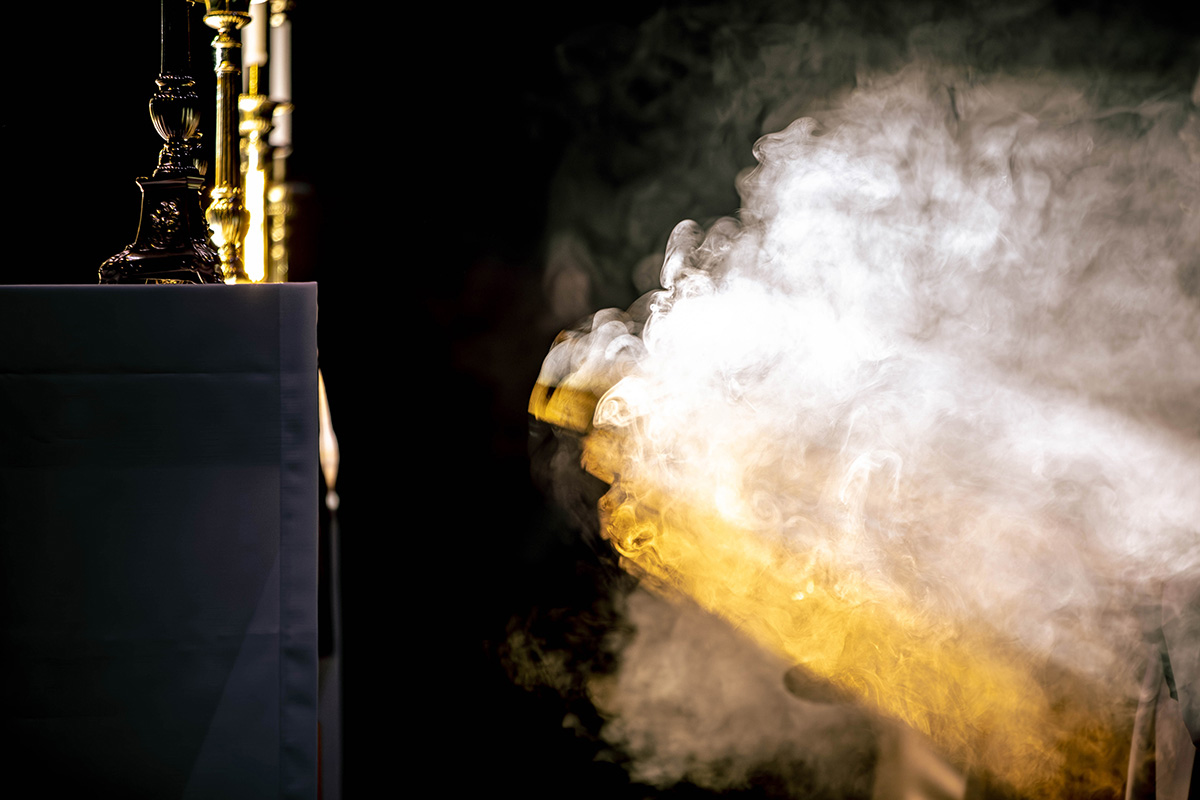
A faint scent of honey and wax lingers in the air, mingling with the spice of incense.
It smells like home.
To the right of the altar stands the tabernacle—a gold-colored cabinet that houses the sacramental bread, the Body of Christ. Before it, a red sanctuary lamp burns at all times, day and night, just as a lamp once burned before the Tabernacle of the God of Israel.
I bow to the Lord as if He were truly present—because He is. As if the risen Christ stood, whole and entire, beneath that quiet, steady flame. Of course, Jesus is not a wafer, or a loaf of bread, or—as some scoffers like to say—a cracker. Yet He said, “I am the bread of life.”
He sustains like bread. Like water.
I used to wonder at people kneeling, even prostrating themselves before the tabernacle, adoring the Blessed Sacrament. But now, when I think of heaven—of seeing Him face to face—and how I will fall to my knees and call Him King, I don’t wonder anymore.
Now, by faith.
Then, by sight.
I don’t want to rise from my knees.
I understand the elders in Revelation who fall before the Lamb, casting their crowns and crying, “Glory!”
The Liturgy of the Word rolls on—ancient prayers, psalms, and hymns. An erudite and witty homily from Father.
The collection is taken for the church and the poor.
ready
And then—it is time.
The Liturgy of the Eucharist is about to begin.


Leave a Reply