I Believe in the Fall

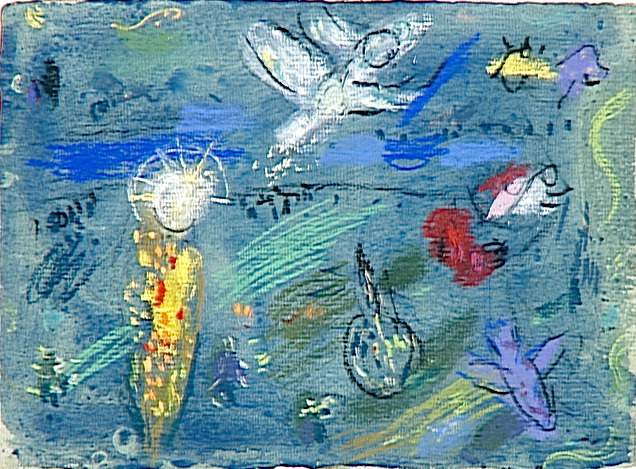
Marc Chagall, Adam and Eve Expelled, featured image for "I Believe in the Fall," The Third Eve

I believe in the fall

I believe in the Fall—the Biblical account of humanity’s first disobedience, as told through the story of Adam and Eve—not as a literal event, but as a profound figurative truth. It resonates because human beings consistently display a troubling tendency to ignore what’s right and true. We turn away from truth with habitual ease, often embracing delusion with a kind of reckless pride. Despite Wisdom’s urgent and public cry—”She raises her voice in the public square,” as Proverbs so vividly puts it—we persist in our self-important ways, deaf to her call and blind to the consequences.

Wisdom shouts in the street,
She lifts her voice in the square;
At the head of the noisy streets she cries out;
At the entrance of the gates in the city, she utters her sayings:
“How long, O naive ones, will you love simplicity?
And scoffers delight themselves in scoffing,
And fools hate knowledge?
“Turn to my reproof,
Behold, I will pour out my spirit on you;
I will make my words known to you.
“Because I called, and you refused;
I stretched out my hand, and no one paid attention;
And you neglected all my counsel,
And did not want my reproof . . .

Proverbs 1:20-25, New American Standard Bible

If you are wise, you are wise for yourself, and if you scoff, you alone will bear it.

Proverbs 9:12, New American Standard Bible

Although age alone doesn’t grant wisdom, experience thoughtfully lived does. Now that I’m old enough to look back over a wide stretch of life, I’ve realized something unexpected: wisdom is a resource—for me. It doesn’t always translate, persuade, or prevent when shared. But like a patient investment, wisdom accrues value over time—available to anyone willing to engage in reflection and growth.

It’s often easier to accept good advice on the big, frightening issues—the ones that keep us awake at night—than on the smaller, everyday matters. Fear tends to be a stronger motivator than reason. When everything seems fine, we tend to dismiss advice from others, when people often make stupid decisions when everything is fine.

Growth in character happens gradually, little by little. If we want to grow wiser, the first step is to pay attention to advice—no matter how small or seemingly insignificant. Wisdom may be speaking.

Listen actively. Learn openly. Ask questions. Consider the possibility—even the remote one—that you might be mistaken. If you haven’t received advice lately, ask yourself whether it might be because of how you responded the last time. Perhaps you’re more resistant than you realize.

Of course, sometimes the problem lies with the advice-giver. They may offer unsolicited counsel, enjoy hearing themselves talk, or come across as judgmental or arrogant. When receiving unasked-for advice from such voices, it’s often best to smile sweetly and say, “I’ll think about it—thanks for caring.”

But if each of us commits to growing in grace and wisdom, we can help make the world—and our families—better places.

And one last thing: When tempted to offer unasked-for advice, don’t.

Simple.


2 responses to “I Believe in the Fall”

  1. Mat Avatar
    Mat

    i wonder if it is possible to be both humble and confident in yourself.

    i know christians believe that believing in yourself, or having any other foundation than god, is pointless, because all humanity is inherently worthless outside of utter submission to god(which in practice tends to be religious leaders…)… but from a purely practical, even materialistic viewpoint, is it possible to love yourself without viewing yourself as more valuable than everyone else, which seems to be the foundation of pride? if it is possible, how do you get there?

    Eve responds: Hello, Mat. Yes, I do think it is possible to be both humble and self-confident. Jesus was a good example of that; also Paul, after his conversion, and many other historic figures. I don’t believe that believing in yourself is “pointless,” unless I misunderstand what you mean. I also don’t think that “all humanity is inherently worthless.”

    I do think we can love ourselves as part of the universal One, without needing to be better. We are just different from each other (and yet much the same, too).

    The how to get there part? Hmm…. good question. The first answer that comes to mind is with God’s help, and the second is “through suffering.”

  2. henitsirk Avatar

    Not to be flip, but this speaks to my thoughts about blogging and commenting. So often I write long comments and then ask myself, did the blog author ask for my life story? Is that an assumption in writing a blog post, or is it actually annoying? Is blogging just a bunch of people giving their unasked-for opinions and advice? Is there any humility here?

    Eve responds: Anthromama, you mused, “So often I write long comments and then ask myself, did the blog author ask for my life story? Is that an assumption in writing a blog post, or is it actually annoying? Is blogging just a bunch of people giving their unasked-for opinions and advice? Is there any humility here?”

    Wow, I just love your comments and musings. My immediate reaction to these questions of yours is:

    Speaking only for myself (of course), yes, I do want your life story, so to speak, in your comments. This is what fascinates me about blogging. We give our stories in exchange, we hope, for the stories of others. At least, this is what I am doing. But I’m genuinely curious about and interested in others. I only have this one life of mine–but how I love to look into the lives of others and see how they live and think and feel! It’s a joy and blessing. So, yes, I do want your life story.

    Is blogging a bunch of people giving unasked-for opinions and advice? Perhaps, but I think that blogging–the act of putting one’s thoughts, feelings, and ideas out there into the blogosphere–is an invitation. It invites people to comment if comments are allowed, and thus invites opinions, advice, reaction, and sometimes judgment, anger, and other negatives.

    You asked if there is any humility “there,” I suppose there in the uninvited advice or opinion. I think that depends on the person offering something. The mere act of advising someone or offering opinions is neither proud nor humble–it’s the person or the motivation at the moment, right?

    We question ourselves with the idea of being humble (as in, “What do you know?”–but listening to one’s spirit or intuition or whatever you want to call it, which is so often beating with the heart of God, takes real humility (in my opinion).

Leave a Reply

Discover more from The Third Eve

Subscribe now to keep reading and get access to the full archive.

Continue reading