the anima archetype
In this essay, I will explore the concept of the anima as understood within the framework of Jungian psychoanalytic theory1. Specifically, “anima” refers to the feminine psychological tendencies described in traditional models, which serve as foundational elements in understanding the complexities of the human psyche. However, it’s important to recognize that this definition is just the starting point; the landscape of psychological theory is ever-evolving, growing alongside humanity itself. As we delve into these ideas, we will uncover how the anima not only reflects historical perspectives but also continues to shape contemporary understandings of the self.
I previously discussed archetypes and their functions, briefly touching upon the concepts of the anima and animus. In this article, I’ll delve deeper into the anima, which represents the archetypal, unconscious feminine aspect. As an archetype, the anima resides within the collective unconscious and exerts a profound influence on culture. While this psychic structure transcends gender, I’ll first explore the influence of the anima specifically among men.
Psychologically, the anima serves as a man’s soul, so to speak. Jung referred to the anima as “the archetype of life itself,” emphasizing the importance of maintaining an ongoing dialogue and partnership with one’s personal anima. When a man is full of life, he is said to be “animated.” Conversely, a man disconnected from his soul often feels dull and listless, projecting those same qualities outwardly. This state—whether termed depression or boredom—is a malaise that has been recognized since ancient times. For thousands of years, among so-called primitive peoples, this condition has been described as a loss of soul.
Psychologically, the anima functions
in a man as his soul.
the emergence of the anima
The inner feminine often emerges in a man’s dreams simultaneously with the appearance of his shadow self. In these dreams, the anima typically takes the form of a female figure, while the shadow side is represented as male. A man’s internal image of woman is initially shaped by his experiences with his personal mother or closest female caregiver. This image is later influenced by interactions with other women—friends, relatives, and teachers. However, the impact of the personal mother is so profound and enduring that a man often finds himself drawn to women who resemble her, or conversely, to those who are her direct opposite. In essence, he may yearn for the comfort of the familiar or seek to escape it at all costs.
The anima embodies all the feminine psychological tendencies within a person, including prophetic hunches, intuitions, moods, receptivity, the capacity for personal love, an appreciation for nature, and the connection to the unconscious.2 Just as females in ancient times served as diviners to discern the divine will and forge a connection between humanity and the gods, the anima plays a similar role, linking a one to the great unknown.
stages of anima development
Jung distinguished four broad stages of the anima in the course of a man’s psychological development. He personified these as Eve, Helen, Mary, and Sophia according to classical stages of eroticism.
 In the first stage, Eve, the man’s Anima is completely tied up with the mother–not necessarily his personal mother, but the image of the woman as a faithful provider of nourishment, security, and love. The first Eve represents all that is natural, instinctual, and biological. The man with an anima of this type cannot function well without a vital connection to a woman and easily falls prey to being controlled by her. He may suffer impotence or have no sexual desire at all. Other ways in which this type of anima possession manifests are through fear of accidents or disease, or in a sort of dullness of personality. The Greek Sirens or the German Lorelei personify this dangerous aspect of the anima, which may even lead a man to his death. This illustrates what is true of other psychological content, namely that it has two aspects, benevolent and malefic.
In the second stage, personified in the historical figure of Helen of Troy, the Anima is sexual being with collective appeal. She is Marilyn Monroe, Madonna, and Angelina Jolie. The man under her spell is often a Don Juan who engages in repeated sexual adventures. These will invariably be short-lived for two reasons: he has a fickle heart, and no real woman can live up to the expectations that go with this unconscious, ideal image.
 The third stage of the Anima is Mary, who raises love to the heights of spiritual devotion. It manifests in religious feelings and a capacity for genuine friendship with women. The man with an anima of this kind is able to see a woman as she is, independent of his own needs. His sexuality is integrated into his life, not an autonomous function that drives him. He can differentiate between love and lust. He is capable of lasting relationships because he can tell the difference between the object of his desire and his inner image of woman.
In the fourth stage, as Sophia (meaning “wisdom”), a man’s anima functions as a guide to the inner life, mediating to consciousness the contents of the unconscious. Sophia is behind the need to grapple with the grand philosophical issues, the search for meaning. She is Beatrice in Dante’s Inferno, the creative muse in any artist’s life. She is a natural mate for the archetypal Wise Old Man in the male psyche. Jung commented that “in the psychic development of modern man this stage is rarely reached,” a comment first published in 1964 and which still rings true today.3
Theoretically, a man’s anima development proceeds through these stages as he grows older. When the possibilities of one have been exhausted, the psyche stimulates the move to the next stage. This move seldom happens without a struggle or a crisis of some sort that helps to move a man forward in his anima development, but the move forward is always worthwhile, for it leads him ever onward, to his true inner home.
pitfalls
As with any psychological content, anima relations have their pitfalls. For example, a man may be captured by his anima, so to speak, and so identify with her that he finds her in an actual woman, marries or partners with her, and is led away from his responsibility to himself. In fairy tales, this problem is often represented by the false bride character.
When inner realities are not recognized or owned, they appear in the outside world through projection. Thus, if a man’s anima is lonely and desperate for attention, he will tend to fall in love with dependent women who demand his time and energy. The man with a mother-bound anima will choose a woman who wants to take care of him. The man not living up to his potential will be attracted to women who goad him on and make more of him than he would otherwise be. In other words, whatever qualities a man does not recognize or develop within himself will confront him in real life.
Negative manifestations of the ignored or repressed anima can be seen in a man’s waspish and poisonous remarks, whereby he gives the image of a person playing a destructive intellectual game. He may become such a pseudo-intellectual that he loses all joy and spontaneity in life and becomes stalled by always ruminating on it.
Jung pointed out that the problem of admiring or worshiping the anima in a collective sense, as in goddess worship, is that she loses her individual aspects as soon as she is shared. A man’s anima is meant to be his and his alone; once she is projected into the world rather than integrated into his very being, a man becomes either a “victim of his erotic fantasies or compulsively dependent on one actual woman.” 4
notes
- Developed by Carl G. Jung, analytical psychology is an approach to understanding the human psyche. It emphasizes integration of conscious and unconscious elements. ↩︎
- Feminine psychological tendencies as described in traditional frameworks include traits like nurturance, caregiving, sensitivity, empathy, and expressiveness. Another framework for the feminine psyche was introduced by Jungian analyst Toni Wolff. ↩︎
- Jung, Carl (Ed.). Man and His Symbols. New York, Dell, 1964, p. 195. ↩︎
- Ibid., 198. ↩︎
suggested reading
- Animus and Anima, by Emma Jung.
- Transforming Sexuality: The Archetypal World of Anima and Animus, by Ann & Barry Ulanov.
- The Archetypes and the Collective Unconscious, by Carl G. Jung.
- Iron John: A Book About Men, by Robert Bly.
- Absent Fathers, Lost Sons: The Search for Masculine Identity, by Guy Corneau.
- He: Understanding Male Psychology, Robert Johnson.
- King, Warrior, Magician, Lover: Rediscovering the Archetypes of the Mature Masculine, by Robert Moore & Douglas Gillette.
featured art
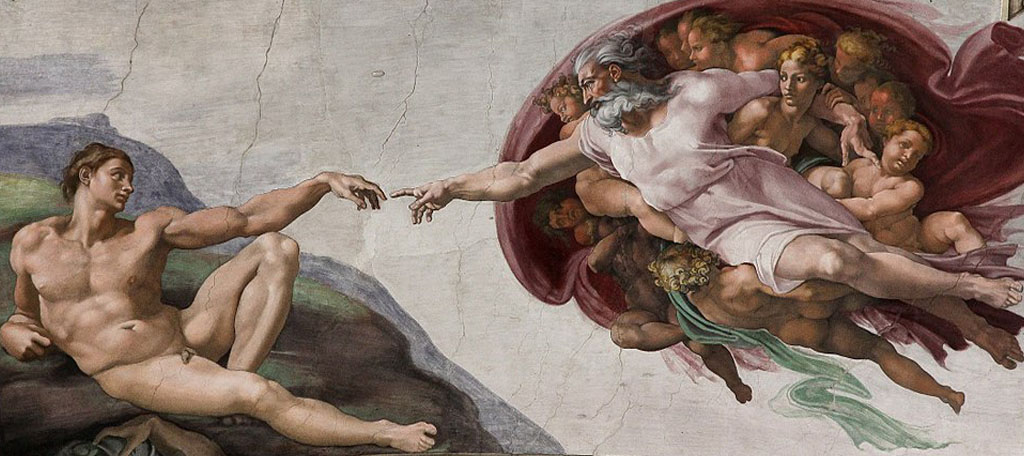
michelangelo, “creation of adam,” 1511


Leave a Reply