
An introduction to Structuralism in Psychology, tracing its origins under Wilhelm Wundt, its formal development through E. B. Titchener, and key early contributors like Ebbinghaus and Müller who shaped experimental psychology.
mapping the mind: the rise of structuralism
Before psychology became the domain of therapy couches, behavioral conditioning, or brain imaging, early pioneers faced a fundamental question: What is the mind actually made of?
Enter Structuralism—psychology’s early attempt to systematically break down human consciousness into its basic elements, much like a chemist mapping the periodic table.
what is structuralism?
Developed primarily by Edward Bradford (E. B.) Titchener, a British psychologist trained in Germany, Structuralism framed the primary goal of psychology as discovering the nature and structure of elementary conscious experiences.
Titchener made a critical distinction between two central terms:
- Consciousness: The sum of human experience as it exists at a single, specific moment.
- The Mind: The total accumulation of those experiences throughout a lifetime.
To understand either, structuralists argued you had to analyze consciousness into its individual, isolated parts.
titchener vs. wundt: the translation break
While Titchener’s name is almost synonymous with Structuralism, he built his theory on the work of his teacher and mentor, Wilhelm Wundt—the founder of the world’s first formal psychology laboratory in Leipzig, Germany.
For nearly a century, popular history treated their views as almost identical. However, modern psychological historians have revealed key differences that Titchener’s English translations obscured:
- Wundt’s View: Recognized the components of consciousness, but focused heavily on apperception—the belief that the mind has the active power to voluntarily synthesize mental elements into higher cognitive processes.
- Titchener’s View: Focused directly on the static elements forming the structure of consciousness itself, setting aside Wundt’s emphasis on voluntary synthesis.
systematic introspection
To uncover these mental components, Titchener relied heavily on systematic experimental introspection.
Unlike simple self-reflection, this required rigorous training. Observers were taught to describe their precise conscious state rather than the external stimulus itself, producing detailed qualitative reports under strict laboratory conditions.
In his foundational work, A Text-Book of Psychology (1909), Titchener outlined the job of the structural psychologist through three core questions:
- What? — Answered by analyzing mental experience into its primary elements.
- How? — Answered by formulating the laws governing how these elements connect.
- Why? — Answered by explaining mental processes through their parallel processes in the nervous system.
Ironically, in his later years, Titchener moved away from strict elementalism and introspection, leaning toward a broader phenomenological approach. Had he lived longer, he may have reworked Structuralism entirely. Thus, his was what appears to be an unfinished legacy.
Consciousness involves mental processes taking place at the moment, while mind involves the total aggregation of these experiences over a lifetime.
e. b. titchener
key pioneers expanding the boundary
While Wundt and Titchener built the framework, other early researchers proved that experimental psychology could reach far beyond basic conscious elements.
1. Hermann Ebbinghaus (1850–1909)
- The Breakthrough: Wundt believed higher mental processes like learning couldn’t be studied scientifically. Ebbinghaus proved him wrong by founding the empirical study of memory.
- The Methodology: Testing on himself, he invented nonsense syllables—neutral letter groups—to measure raw memory without emotional context.
- Key Findings: Memorizing nonsense material took about nine times longer than meaningful content. He also developed an early sentence-completion test still reflected in modern assessment instruments.
2. Georg Elias Müller (1850–1934)
- The Breakthrough: Operating a laboratory at Göttingen for 40 years, Müller advanced Ebbinghaus’s objective methods by combining them with subjective introspection.
- Key Findings: Demonstrated that learning isn’t purely mechanical. He identified conscious attitudes—like readiness, hesitation, and doubt—that actively shape memory, and proposed the Interference Theory of Learning (the idea that forgetting occurs because new material actively interferes with older memories).
references & further reading
- Danziger, K. (1979). The positivist repudiation of Wundt. Journal of the History of the Behavioral Sciences, 15(3), 205-230.
- Ebbinghaus, H. (1885). Über das Gedächtnis: Untersuchungen zur experimentellen Psychologie [Memory: A Contribution to Experimental Psychology]. Leipzig: Duncker & Humblot.
- Leahey, T. H. (1981). The mistaken transformation of Wundt’s psychology into Titchener’s structuralism. Journal of the History of the Behavioral Sciences, 17(1), 3-12.
- Titchener, E. B. (1909). A Text-Book of Psychology. New York: Macmillan Publishing.

featured art
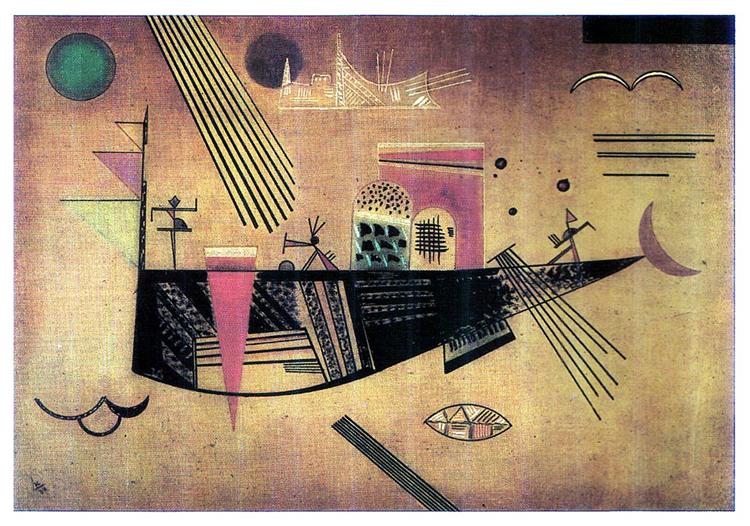
wassily kandinsky, “capricious,” 1930
Kandinsky’s work was included in the 1937 Degenerate Art exhibition held by the Nazis in Munich, so named to inflame public opinion against modernism.
Leave a Reply