
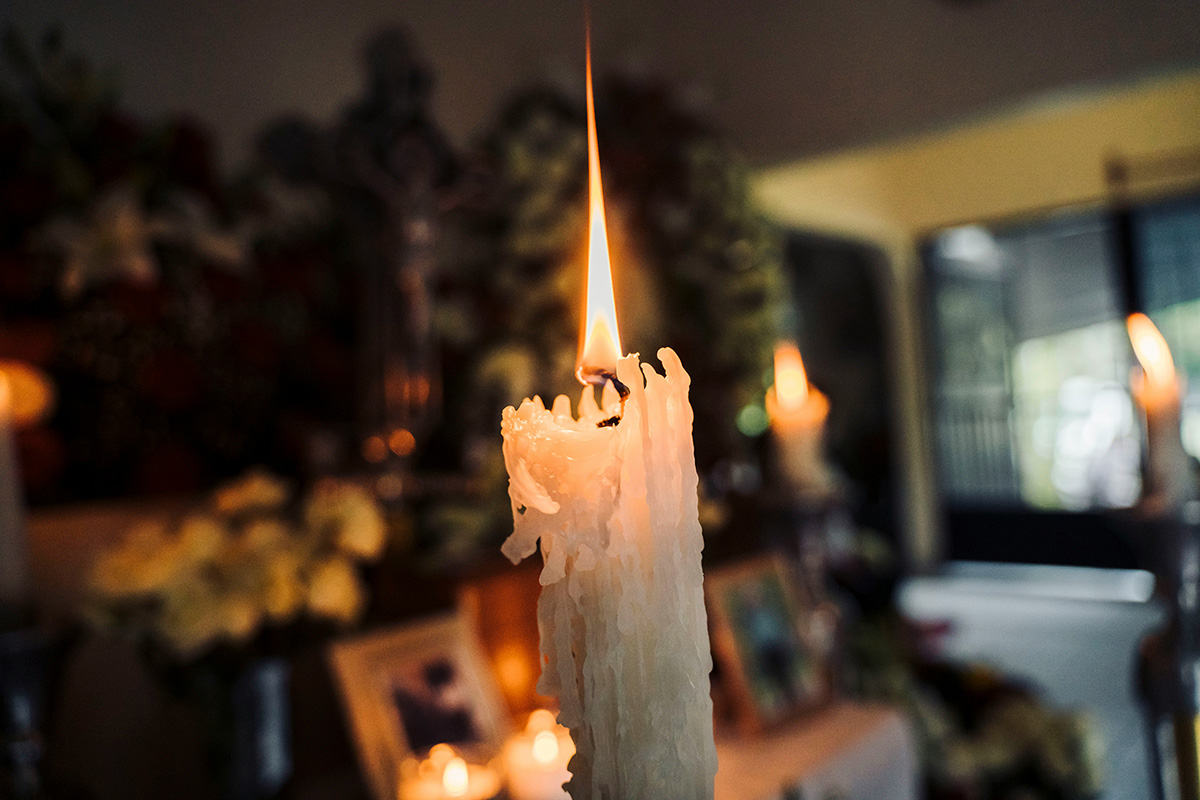
Yesterday we went to the funeral of our friend who was killed in a car accident last week. Seeing the stricken faces of the children who look so much like her was more than we could bear. This grief is persistently with me, knowing they will never be the same again.
There’s nothing anyone can do for her survivors at the deepest level, because grief is like birth: though surrounded by people, one goes through it alone. The redemption of the situation is in knowing that many other people have experienced traumas and griefs just as harrowing. In their loss, they’ve felt just as lonely.
The casket was opened at the end of the service. I don’t generally approve of the American way of death, wherein the body becomes a spectacle—a plastic, creepy-looking thing that hardly resembles the living person. In the case of our friend, though, opening the casket felt necessary. Because her children were still at a concrete stage of development, they needed to see with their own eyes that their mother was dead. It offered a necessary finality. They knew, without ambiguity, that they would not see her alive again in this world.
In conversation afterward, it was clear that everyone was trying to work out how such a tragic accident could have happened to such good people. Judgments quickly began to take shape. Conversations were liberally seeded with should, ought, and wrong. I haven’t been able to think or feel my way through it adequately, because on a deep level I believe this suffering is simply senseless.
One worries over the senselessness of such agony the way a tongue worries a broken tooth. It is jagged, out of place, disturbing. Even after it is fixed and only the memory of the sharp edge lingers, the mind returns to touch it, remembering the sudden, violent loss.
The uncertainties of life—and the desperate ways people try to manage them—have my full attention this week.
The rush to judgment after our friend’s death was unmistakable. Sudden, arbitrary tragedy creates an unbearable uncertainty. People rush to judge because judgment creates a illusion of certainty—and certainty makes us feel safe. There are no agonizing question marks in “Thou shalt” or “Thou shalt not.”
We readily judge others right up until we stand at their funerals. Surrounded by the grief of those who loved them, our harshness dissolves into empathy. Otherwise, we move through the world evaluating and condemning, with many building their daily conversations, their substacks and blogs, and even their livelihoods on judgment alone.
It is so much easier to judge others than to love them. How far we stray from the ways of Love when we grant ourselves the freedom to judge.
I’m reminded of the admonitions of Saint James on the topic:
Do not speak against one another, brethren. He who speaks against a brother, or judges his brother, speaks against the law, and judges the law; but if you judge the law, you are not a doer of the law, but a judge of it. There is only one Lawgiver and Judge, the One who is able to save and to destroy; but who are you who judge your neighbor?
Come now, you who say, “Today or tomorrow, we shall go to such and such a city, and spend a year there and engage in business and make a profit.”
Yet you do not know what your life will be like tomorrow. You are just a vapor that appears for a little while and then vanishes away.
Instead, you ought to say, “‘”If the Lord wills, we shall live and also do this or that.” But as it is, you boast in your arrogance; all such boasting is evil.
James 4:11-17, New American Standard Bible
How unlike Love I am when I insist on the rightness of my belief, and condemn you for yours. How arrogant I am when I forget that our lives are “just a vapor.”
After my daughter died, I spent the better part of a year immersed in Buddhism. I learned that in Buddhism nothing is permanent—a truth that belongs to Christianity, too. But Western Christianity has often made a mockery of its own tradition, trading its transcendent depth for dogma and damnation.
In the past, I was far too free with my own dogmas, judgments, and platitudes. I was all too ready to offer simplistic, shallow explanations for why things happen as they do.
Now, I admit I cannot possibly know the why of things. This uncertainty is a humbling, comforting space. It is where mercy finally triumphs over judgment, and it is a good place to be.


Leave a Reply