Lord, Hold Us in Your Mercy

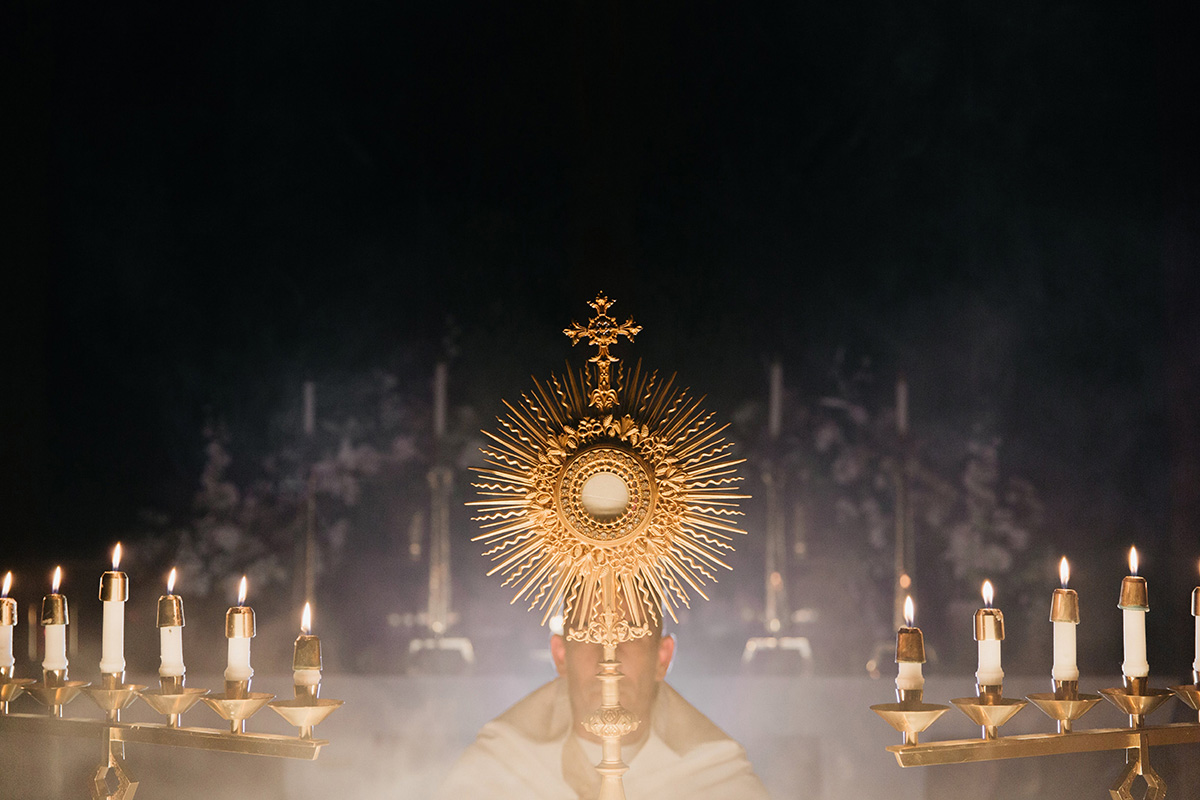
Elaborate gold monstrance with cross at top, carried by priest; lit candles flanking in a hazy background; art for "Lord Hold Us in Your Mercy" at Third Eve

Light filters through stained glass—scenes from Jesus’ life pooling in color at our feet. The altar’s gold gleams as if alive. A trace of incense lingers in the air.

We sit on Mary’s side of the sanctuary, beneath Our Mother’s statue—hands outstretched in quiet welcome. Candles flicker in red glass votive holders.

My husband leans close and softly says,
“She heals me.”

Father Tom is away on a mission. The visiting priest—a small man with elegant hands—preaches with unexpected fire, his voice insistent: repent, remember our privilege.

The ancient liturgy flows over me, like water poured by loving hands.
I know I am loved. I know, too, I am not worthy.

Lord, I am not worthy to receive You;
but only say the word, and I shall be healed.

The bread and wine mingle in my mouth, the body and blood of Christ.

There is no forgiveness without the shedding of blood.
And no child is born without it.
The blood of mothers—offered without altar.
A different kind of sacrifice.

We sing a Lenten song—Lord, hold us in your mercy.

Hold us in your mercy
Mercy is made flesh among us
Hold us in your mercy
Lord of all the homeless pilgrims
Hold us in your mercy
Sent to bring the poor good news
Hold us in your mercy
You who shared the sinner’s table
Hold us in your mercy

The words linger as we pass by Mary. Her hands are still lovingly outstretched, her head bowed—in deference, in humility, in invitation. I cannot say.

I light a candle:
for the motherless children,
for the childless mothers,
for all who long for a Mother.

I’m reminded of a verse in Ecclesiastes: It is good to grasp one thing and not let go of the other, but—we only have two hands.

To live with this dilemma, a good parent raises an aware child. A good parent says, “There is this, and there is also this. Look here; see one thing. Now look here; see the other.” As the child grows, the parent offers more: this, and then that, and then another—until the child begins to see a vast universe of possibilities. A still vaster array of human beings, each genetically unique, each impossibly wonderful, lovable, beloved.

That child becomes an adult who can choose—not because every choice is given, but because they have learned how to discern. In learning to see many things, they come to know that not all things can be held at once. Some choices exclude others. Some must be made alone. Perhaps only one choice is possible at a time—or two. Five might expand the soul. But all cannot be held at once by one person.

This is the way of adoption.

In one hand, we hold the necessity of respect for the ancestors, among whom birth parents stand—those whose children were given up, or taken. Whatever their sins of omission or commission, we teach respect, honor, and approbation for all whose blood and lives form the foundation of our presence in the world.

In the other hand, we hold the wounded soul of the orphan. That person, too, is worthy of reverence. They have the right to choose relationship—or not. To seek healing. To stand on their own feet. To do what it takes to become whole, even at the expense of birth or adoptive parents. The adopted person has that right.

And then I wonder: with our two hands full, is there room for the adoptive parent?

Must we put down the birth parent, or the adopted person, in order to lift up the adoptive parent? If we honor the claims or love of the adoptive parent, must we abandon that of the birth parent—or the adopted person?

In human terms, it is a conundrum.


The incense of an African-American spiritual rises in my mind:

He’s got the whole world in His hands,
He’s got the whole world in His hands.

African-American spiritual

Lord, hold us in your mercy.

When I rise from my knees, I know: Love is big enough to hold us all. The two-handed Either-Or is transformed—through love and wisdom—into the welcome of Either–And–Or.

The candle sputters as I light it, flickering a little in the red glass. I drop a coin into the box to pay for more candles. God knows I’ll need them, as I pray week after week for all who need the gentling of a Mother.


Marian Anderson sings He’s Got the Whole World in His Hands, 1953

7 responses to “Lord, Hold Us in Your Mercy”

  1. Eve Avatar

    Anthromama, wow again. Just, WOW. I love this idea–it’s so darned Jungian!

    Not yet. How many times must a parent say “not yet” to their child? So many times, and children hate it. They hate to wait.

    Oh heck, I’m an adult and I hate to wait, too. I want to know it or have it or do it now.

  2. henitsirk Avatar

    Well, I’m always a bit loath to recommend reading Steiner, because many of his works are extremely “out there”. Sometimes I think he really talked a bit too much!

    But he did have some fascinating things to say about Christianity and Jesus, in any case. My understanding is that he also believed that God intended for our eyes to be opened, but that Lucifer opened them too soon. (He distinguishes between Lucifer and Satan, but that’s a whole other conversation.) Lucifer brought consciousness (suddenly they knew they were naked) into the unconscious paradisaical state. Which is mirrored in each human being’s transformation from a relatively boundaryless baby to an individual consciousness, intimated when the child first says the word “I”.

    So when God told Adam and Eve not to eat the shiny yummy apples, he just meant “not yet”! And therefore we have a misconception of original sin, in that it wasn’t the depraved woman’s fault, it wasn’t evidence of our lack of divinity–rather it was that we were exposed to the allure of consciousness too soon. And consciousness is so alluring–why else do kids fight going to bed at night? They don’t want to miss anything!

    We could say that Lucifer is the bearer of all the “original” sin, and that is why instead of being the light-bearer, he was cast down,–whereas God still allows humans to work toward perfection.

    Man, you’d think I went to church or something ; )

  3. Eve Avatar

    Anthromama, you made a good point about the error made by the centurion. Of course he was worthy, since Jesus was already preparing to go to this house! I never really thought about it that way until now. Thanks for that.

    About original sin, my personal take on the concept is that people preach it wrong. To me, the concept says “I am human”–as God intended.

    I recently read works by St. Symeon and Anselm of Canterbury, who each believed that God intended the fall of man, the opening of man’s eyes, etc. I think Protestantism cut Christian traditions away from traditional understandings of doctrines such as original sin, and most westerners no longer have an understanding of what these meant to church fathers. Such widespread ignorance has resulted in a widespread rejection of Christianity—although in my humble opinion, what’s being rejected is Stupid Christianity, not the teachings of Jesus.

    The shorthand I’m using could brand me as a heretic, but honestly… God leaving Adam and Eve in the garden and saying “don’t touch that tree” had the same outcome that resulted from leaving Pandora with the box, or the same outcome we’d experience by leaving a four-year-old alone in the kitchen with the cookie jar after admonishing, “Whatever you do, do NOT touch that jar!”

    These are issues I’ve thought about for a long time and continue to think about. When I read that St. Symeon and Anselm of Canterbury agreed with me, and had written about it centuries ago, I felt smart of soul.

    Re: Rudolf Steiner. I’ve not read him, I’m ashamed to say. I’ll add him to my list of people to read on the way to becoming well read. Thank you. You’re a treasure.

  4. henitsirk Avatar

    Thank you, Eve, for such a thoughtful response. I’ve been lurking all day waiting for it! : )

    I suppose adding “under my roof” makes a world of difference. Then it seems to me you’re not speaking of intrinsic unworthiness, such as is implied in the doctrine of original sin, but of somewhat temporary, or even temporal unworthiness.

    Funny though, how Jesus time and again told people that all the Jewish laws were no longer necessary, and that anyone could enter the kingdom of God. So really, the centurion was being humble, but was in error in saying he wasn’t worthy. Jesus surrounded himself with a lot of “unworthies”.

    I guess I could come to accept this concept of unworthiness in terms of remembering that we always have farther to go on our path to perfection, that we always require humility as fallible human beings.

    Interesting that you mention the “spiritual and genetic inheritances of Israel”. Rudolf Steiner believed that the mission of the Jews (in a global, human spiritual evolution sense) was to create the perfect vehicle for Christ’s incarnation, that is, Jesus of Nazareth (Steiner believed that Jesus was not divine until the Baptism.) So that after Jesus became Christ, the religious and social doctrines that informed the Jewish religion were no longer necessary in a sense. I don’t know if Steiner ever spoke specifically about the centurion, but I’ll try to find out.

  5. Eve Avatar

    Anthromama… wow, talk about asking a great question! What does it mean, when I say I’m not worthy?

    In the original language, this part of the liturgy is from the encounter between Jesus and the Roman centurion (Matthew 8). The centurion’s servant was paralyzed and in agony, so the centurion approached Jesus and asked him to heal the servant. Jesus prepared to go to the centurion’s home to heal the servant, but the centurion replied, “Lord, I am not worthy to receive you under my roof; but only say the word, and my servant shall be healed.” He explained that he was a man of authority who was also under authority, and if he told a soldier, go, do this, the soldier would go.

    In similar fashion, if Jesus commanded the servant to be healed, the centurion knew that He had the authority to heal–and the servant would be healed. And, according to Matthew, the servant was healed “that very hour.”

    During the post Vatican II era, the medieval language of this part of the liturgy was changed from, “Lord, I am not worthy to receive you under my roof,” to “Lord, I am not worthy to receive you.” The Catholic church is in the process of reverting to the original language, though.

    What difference does it make? Well, for me it means that I am like that Roman centurion: I’m not worthy in the strict sense of benefiting from the spiritual and genetic inheritances of Israel. In the looser sense of general worthiness, were Jesus Christ to appear in the flesh again—healing the sick, raising the dead, walking on water, etc. I think I would nevertheless have the same reaction to his holiness that the Roman centurion had: I am not worthy of you.

    I’m reminded of the Revelation scene in which no one was worthy to take the scroll and break the seal, except for the Lamb of God.

  6. henitsirk Avatar

    That was so beautiful, Eve. Your image of the two hands reminds me that the beauty of love is that we aren’t limited by things such as hands. Your heart is boundless inside. That’s what I believe Jesus was trying to teach us, that we can all be like God in that way.

    Slightly off topic: I’d like to understand more about saying that you’re not worthy to receive Christ. I’ve never been comfortable with that idea–not that we shouldn’t be humble, but that we are unworthy. Maybe I don’t like that interpretation of the concept of original sin. I’m not sure. If you’d rather, email me separately.

  7. renaissanceguy Avatar

    Awesome! May your words help us all to walk in the light.

Leave a Reply

Discover more from The Third Eve

Subscribe now to keep reading and get access to the full archive.

Continue reading