
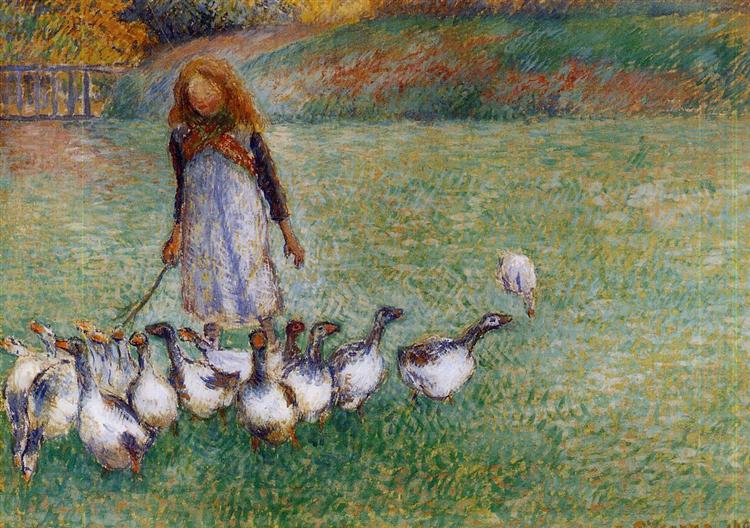
There was once upon a time an old Queen whose husband had been dead for many years, and she had a beautiful daughter. When the Princess grew up she was betrothed to a Prince who lived at a great distance. When the time came for her to be married, and she had to journey forth into the distant kingdom, the aged Queen packed up for her many costly vessels of silver and gold, and trinkets also of gold and silver, and cups and jewels; in short, everything which appertained to a royal dowry, for she loved her child with all her heart.
She likewise sent her maid in waiting, who was to ride with her, and hand her over to the bridegroom, and each had a horse for the journey, but the horse of the King’s daughter was called Falada, and could speak. So when the hour of parting had come, the aged mother went into her bed-room, took a small knife and cut her finger with it until it bled, then she held a white handkerchief to it into which she let three drops of blood fall, gave it to her daughter and said, “Dear child, preserve this carefully; it will be of service to you on your way.”
“The Goose Girl,” Grimm’s Fairy Tales1
Thus begins the Grimm’s fairy tale, “The Goose Girl.” It’s a tale characterizing elements of the good home-leaving for youths moving forward into the independence of young adulthood. The tale opens with an old widow Queen, the Great Mother in her Crone archetype, with a daughter she loved “with all her heart.” She sent her daughter to a distant land to be married, accompanied by her own trusted maid-in-waiting and many riches as a dowry.
It’s clear that the Queen was a good mother who launched her daughter the way a princess ought to be launched. This princess is better equipped for life already by having in her mother an exemplary Wise Old Woman archetype.
So, just as in the monomyth or great Quest literature in which the Hero sets out from his home village with his trusty steed or a knapsack thrown over his shoulder, so too must the goose girl start from somewhere.
We set out confidently, carrying our parents’ gifts and talismans with us, or we rush out helter-skelter, doing what we must to simply get away. Some are pushed out and some are kicked out. The manner in which we leave or are forced to leave home is a golden key that unlocks the mysteries of a lost inheritance. From the way we left, we can see what’s missing and will need to be reclaimed if we’re to grow up and obtain the crown.
Age 50: the time of seven sabbaths
Wise old women become so after many years of conscious, deliberate living, never less, but often more. Suffering is involved. The decade of the 50-60s is just about right for brewing a wise woman. There are so many archetypal, mythical, magical ways in which women can become wise in their 50s that it astounds me that we know and are taught so little about it in our culture of Botox.
There’s a biological basis for large changes in our 50s, since more women enter menopause at age 51 than at any other age. A more nuanced and symbolic reason is that, between age 50 and 51 years or so, every person experiences the astrological archetypal pattern of a Chiron return. Chiron, the centaur, is a wounded healer who returns to rest in the place of a person’s nativity after 50 years. One of the messages of the Chiron return is that a person has had every opportunity for healing their childhood wounds. The 50th year is thus a year of opportunity for great freedom.
The ancient Hebrews knew and wrote the significance of the 50th year into their priestly laws:
You are to count off seven sabbaths of years for yourself, seven times seven years, so that you have the time of the seven sabbaths of years, namely, forty-nine years.
You shall then sound a ram’s horn abroad on the tenth day of the seventh month; on the day of atonement you shall sound a horn all through your land.
You shall thus consecrate the fiftieth year and proclaim a release through the land to all its inhabitants. It shall be a jubilee for you, and each of you shall return to his own property, and each of you shall return to his family.
You shall have the fiftieth year as a jubilee; […] it shall be holy to you.
Leviticus 25:8-12, New American Standard Bible
If a person has benefitted from living their first 50 years and allowed their eyes and hearts to open, the best is yet to come.
This tale begins, as do our personal stories, with the ones we left behind and from whom received our genesis. This young woman left a King Father who had died, and a Queen Mother who was old, loving, and wise. She was sent on her way on a talking horse named Falada, with a magical talisman of blood, many riches and jewels, and a trustworthy handmaid. Her trunks overflowed with royal gifts and inheritances.
Who did you leave when you left home? If you were to characterize your parents as fairy tale figures, what names would their archetypes go by? Were they parents who were able to equip you with anything at all for life’s journey? Did they help you pack your things, or throw them onto the porch after you?
What’s the effect of leaving poorly or too soon? Leaving late, or not at all? What holes and gaps in our characters did you have when you left that you will pass on to the next generation?
What can be changed or transformed and even healed?
What disabling wound did you receive that left you limping for the rest of your life like Chiron, like Jacob?
contemplate & convey
Think about how you left home. Write a paragraph, or imagine that scene of leave-taking, in fairytale form.
Share a blessing or curse you were given upon leaving.
How have your blessings or curses transformed you?
How have you learned to live with your disabling wounds?

footnotes
- Grimm, J. & Grimm, W., Fassett, J. H., Ed. (1904). Grimm’s Fairy Tales. New York, The Macmillan Company. ↩︎


Leave a Reply