threshold
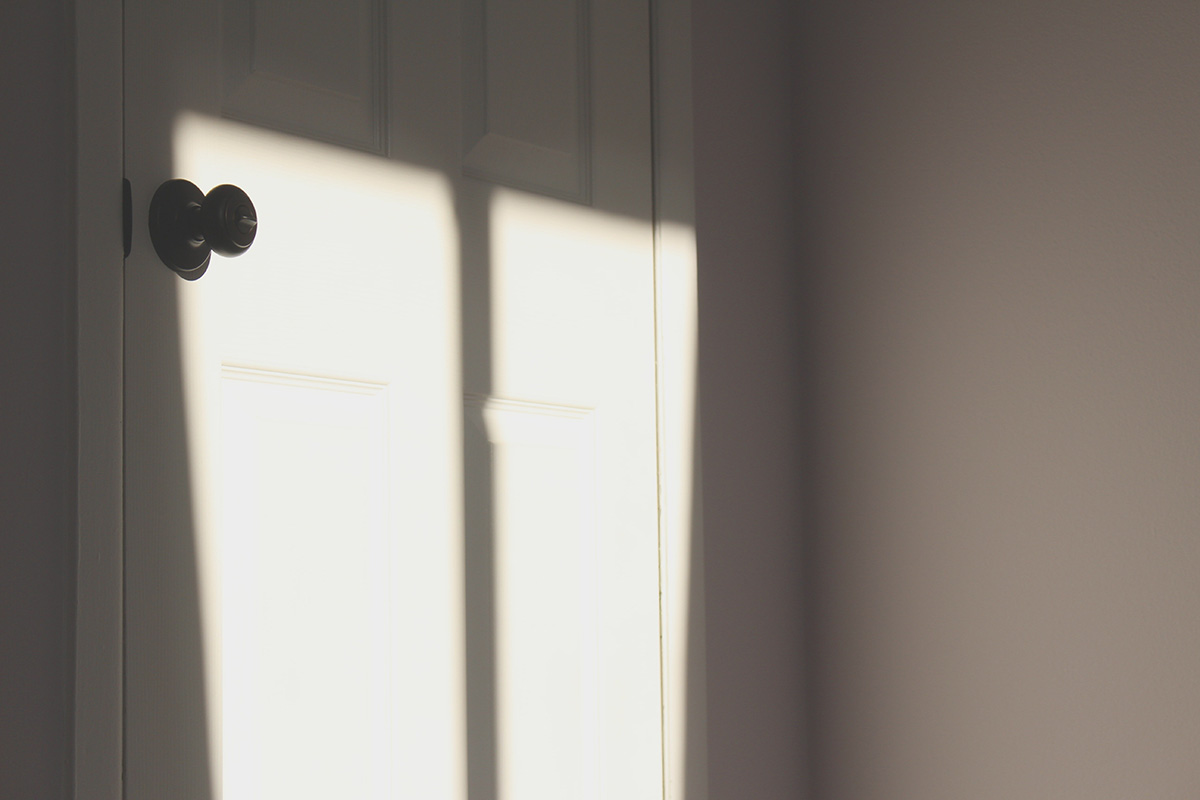
Getting from one end of our large, traditional home to the other can feel like a hike—especially when I’m heading toward the parental bedroom. The house is spacious, with long hallways and rooms that branch off like tributaries, but I’m not the meandering type unless I’m in a bookstore. So when I move through the house, particularly toward my bedroom, it’s clear I have a destination in mind. Even so, it has happened several times now that as I approach the short hallway that leads there, one of my young daughters calls out to me from the kitchen or gathering room table and initiates a conversation.
This sort of interruption has become a weekly occurrence, at least. In the early months, I would stop mid-stride, pause, and patiently absorb the question, commentary, or full-blown soliloquy offered by whichever daughter had summoned me. But as the weeks wore on—and with the frayed nerves of the holiday season creeping in—I began to halt my steps with an audible, irritated sigh. One recent afternoon, it was Rosemary who called out.
“Can you see me walking to my bedroom?” I asked.
Rosemary nodded.
“I’d really appreciate it if you’d stop me there”—I pointed to a spot along the hallway—“or there,” I added, pointing again, “or even there. But not here”—my finger marked the place where I tend to vanish—“when I’m just about to disappear from sight.”
My little girl sighed too.
Of course, my irritable tone bothered me. I felt the guilt rise, but I pushed it aside, finished my mission, and came back to give Rose my full attention. By then, naturally, she’d forgotten whatever urgent communiqué had driven her to call out in the first place.
Several days later, it happened again. The three youngest girls were painting at the farm table. I passed by, admired their work, and continued through the great room, past the fireplace. Just as I rounded the corner into my bedroom, Juniper called out, “Mom?”
Rosemary set down her paintbrush, turned to her sister, and said, with the weary wisdom of someone twice her age, “Can’t you see Mom walking to her bedroom? Why didn’t you stop her there?”—she pointed. “Or there?”—another point. “Or there?”—a final one.
She sounded just like me.
a pattern emerges
I made a quiet mental note: an unconscious pattern had surfaced—one that began with me. A cluster of reactions and emotions, repeated until it took on a life of its own, had stepped into the light.
A complex had revealed itself. Its origin remained a mystery.
Recognition alone doesn’t dissolve a complex—but awareness marks a crossing. To see the pattern, to name it, is to move, however slowly, toward freedom. Not without pain, but with purpose.
That Thanksgiving, our home was as full as ever. We set places for thirty, welcoming the usual mix of family and holiday nomads. Amid the bustle, my parents arrived with the crowd. After greetings and drinks, I sat down with my brother’s fiancée for a long-overdue chat.
We’d just begun when my mother interrupted: “Where’s the yellow bowl I brought?”
I gestured toward the kitchen. “It’s on the counter, Mom.”
She asked again—louder this time, using a term of endearment that clashed with her tone: “Schätzchen, where’s the yellow bowl I brought?”
I made eye contact. “It’s right there, on the counter beside the ovens.”
But she crossed the room and came to stand beside me—too close. Her elbow touched my shoulder. Leaning into the space I reserve as my own, she demanded, “Where is it? I want you to show me the bowl.”
Wordless, I rose and followed her into the kitchen.
Recognition alone doesn’t dissolve a complex—but awareness marks a crossing.
the third eve
To see the pattern, to name it, is to move, however slowly, toward freedom.
Not without pain, but with purpose.
a counterfeit offering
At the counter, she draped an arm around me in a sideways hug and, with an air of solemn generosity, said: “This was your grandmother’s bowl. You said you wanted it, and I brought it for you.”
The lie snapped me back to myself.
I had never seen this dish. It belonged to no grandmother of mine. Having spent years in their kitchens, I knew their bowls, tools and trivets. This was something else entirely—an unfamiliar lidded yellow casserole, not the heirloom I remembered.
She offered this forgery like a benediction, with a smile that never reached her eyes—but it was a conjuring, not a gift. The dish was no heirloom, only a vessel for the story she wished were true. By naming the grandmothers, she did more than embellish—she distorted. What should have been sacred became spectacle. It looked, perhaps, like love, but I felt the fracture. The gesture rang false, and something ancient in me recoiled.
the real heirloom
Earlier that year, we’d spoken of a different bowl—the bowl. The one she uses to make her acclaimed potato salad. The one passed down through four generations of women. Brown with a crater-patterned glaze, cream-rimmed and cracked with age. Narrower and taller than modern bowls, it had made its journey from 19th-century Germany to America in my grandmother’s lap.
This is the bowl I had asked to be given some day, whenever—and if ever—my mother has finished with it.
The lidded, yellow casserole dish in the kitchen had nothing to do with our history—or with me.
I turned toward Mother with a stoneware face and said, “Ah, I see.”
And I did.
awakening
Later that evening, after dinner, I walked from the kitchen through the gathering room and into the sitting area, where fire crackled in the hearth and post-feast contentment had settled in. Family clustered in chairs and on sofas, sipping their drinks, voices low, laughter easy. The mood was golden.
For a moment, I felt the hush of gratitude—the kind that comes only after days of preparation and hours of hosting and navigating everyone’s needs.
I was heading toward my room, ready to retreat, just beginning to breathe in a sense of stillness—
“EVE.”
I stopped in my tracks, mid-stride, and froze. My back was still turned toward her.
“Eve!”
I faced Mother warily.
A stream of senseless chatter poured out, as if her only aim had been to stop me in my tracks—because otherwise, she might as well have been speaking in tongues. Her words dissolved into background static. As I looked at her, I caught sight of my three youngest daughters out of the corner of my eye. Two sat curled together in a chair; the third nestled close to an older sister. They were still, silent—spellbound, watching. They knew What Grandma Had Done.
And in that moment, I knew too.
The irritability, the abrupt halt, the invisible wave of exasperation that surged up whenever I was stopped just before a threshold—it all made sense. This wasn’t about the girls. It wasn’t about the interruption itself.
It was about her. It had always been about her.
This was the shape of overwhelmment—of years of boundary violations, of the insistent press of her need, her control, her call.1 The complex had been there all along, nested inside a mother’s voice, waiting to be named.
What I didn’t yet realize—not fully—was the depth of the pain and rage still coiled beneath it all. All the times I had been compelled to turn back, answer, surrender my path.
When she had finished, I nodded, then turned, and resumed my purposeful walk to the bedroom.
notes
- overwhelmment, n. (1866-) Oxford English Dictionary. The state of being overwhelmed; the state of being overwhelming. Also used in analytical psychology to describe the psychological state and a mother archetype. ↩︎


Leave a Reply