the liturgy of the eucharist
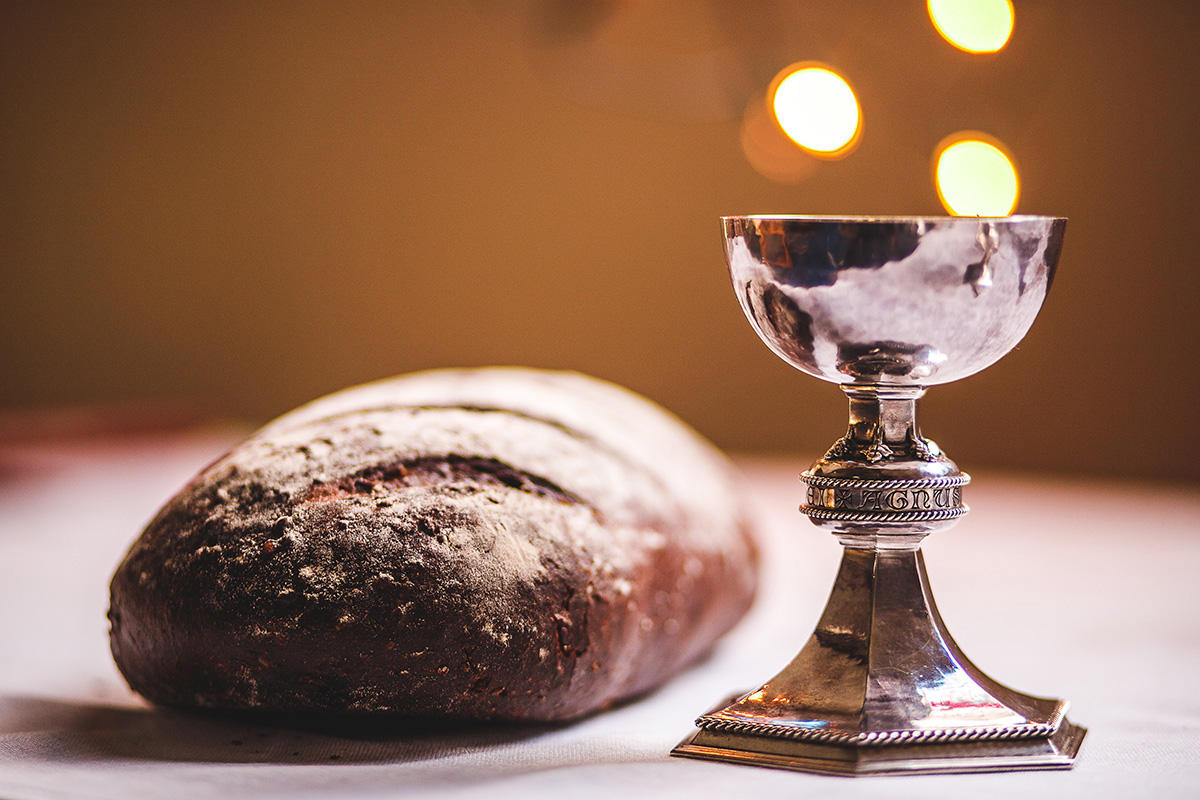
The chalice is heavy in my hands and the smell of the wine wafts up as I follow the sacristan down the aisle to the altar. He carries small crystal cruets of water and wine for the deacon, reminiscent of the water and blood that flowed from the side of Christ on the cross.
I’m breathless with expectancy.
The deacon stands at the bottom of the steps leading up to the altar and receives the cruets; we move around him two by two and place our chalices or patens on the altar, then return to our seats.
The Liturgy of the Eucharist has begun.
Father stands behind the altar, lifting the paten with the bread above it, and quietly prays
Blessed are you, Lord, God of all creation
Through your goodness we have this bread to offer,
Which earth has given and human hands have made.
It will become for us the bread of life.
Blessed be God forever.
The deacon pours wine and a little water from the cruets into the largest chalice, an ordination gift to our priest from his mother, and quietly prays
By the mystery of this water and wine
may we come to share in the divinity of Christ,
who humbled himself to share in our humanity.
Father takes the chalice he has handled at every Mass for 40 years now, and elevates it over the altar, whispering
Blessed are you, Lord, God of all creation
Through your goodness we have this wine to offer,
Fruit of the vine and work of human hands.
It will become our spiritual drink.
Blessed be God forever.
Father bows before the altar, and softly prays, “Lord God, we ask you to receive us and be pleased with the sacrifice we offer you with humble and contrite hearts.” An acolyte hands him the smoking thurible, and he works it over the bread and wine, back and forth, back and forth, incensing the offerings and the altar just as Aaron, the High Priest of Israel, incensed the altar “morning after morning, and again in the evening twilight, “and over offerings, so that “a cloud of incense may cover the propitiatory.” 1
frankincense and myrrh
Then the deacon steps forward and receives the thurible to incense our priest and people. Back and forth, back and forth, he swings the thurible to the east, over the choir. Coming down the steps, he swings it back and forth, back and forth over those on Mary’s side, to the north, where a large statue of the Virgin stands in a niche, hands outstretched. The silence is complete as he moves to the west, working the thurible back and forth, the chime of its silver chains and the gasp of his robes the only sounds in the place.
Incense curls over the people in the main part of the church, drifting to the back where the baptismal font gurgles with blessed water day and night. Finally, he goes south, to the side of the Evangelist whose name our parish bears; the side where the oldest members of the congregation sit. To them, Father takes every newly-baptized baby to be blessed. They trace the sign of the cross with quavering hands.
The incense is heady, frankincense and myrrh, recalling a bone-deep connectedness to ancient rites and mysteries as old as humankind. Modern research has discovered that burning frankincense activates areas of the brain that relieve anxiety and depression. I smile, thinking of God, the great psychiatrist.
Father moves behind the altar, washing his hands in a large crystal bowl set off to the side, praying quietly, “Lord, wash away my iniquity; cleanse me from my sin.” Turning to the people, he intones, “Pray, brethren, that our sacrifice may be acceptable to God, the almighty Father.”
have mercy on us
We are ready to break bread, and be broken.
Lamb of God, you take away the sins of the world
Have mercy on us.
Lamb of God, you take away the sins of the world;
Have mercy on us.
Lamb of God, you take away the sins of the world;
Grant us peace.
As one body, we hit our knees in a whoosh of contrition.
Father says, “This is the Lamb of God who takes away the sins of the world. Happy are those who are called to his supper.”
“Lord, I am not worthy to receive you,
but only say the word and I shall be healed.”
As our priest crumbles a bit of the host into the wine, and then takes communion himself, we Extraordinary Ministers make our way to the altar again, each receiving the Body of Christ and Blood of Christ in turn. “Amen,” we say, “Amen.”
I am given a paten of the host, so move to the north aisle. A statue of the Virgin Mary stands directly opposite me, head bowed, hands outstretched. This is the side my family sits on every week. It’s comforting to sit near the likeness of the Blessed Mother because we have so many mother-loss wounds in our family. Every week, some one or another is bound to light a candle to remember a birth mother or to pray for hearts that will raise up their own inner Good Mothers.
My hands shake as I hold the paten and people begin to line up in the aisle. Not everyone chooses to drink from the common cup of wine, but everyone comes to receive the bread. Before the Mass is ended, I will have touched the hands of one fourth of the people at this Mass. How humbling it is. I’m amazed and bewildered to be standing here, opposite a likeness of the mother of Our Lord, serving communion to my own children. “Thank you,” I breathe. “Thank you.”
body of christ
The first person in line is a middle-aged woman; she bows from the waist and extends her cupped hands.
“The body of Christ,” I say, pressing a wafer into her palm.
“Amen,” she replies, putting the bread into her mouth and crossing herself.
Next is an elderly man, whose hands shake as he extends them.
“The body of Christ,” I say.
He pauses to look me right in the eye, and smiles, “Amen.”
Surprised, I smile back. We’re taught not to interfere with people’s communion by waiting for eye contact or expecting anything other than their “Amen.” This is their time with God; it is a sacred time, not to be intruded upon. But often people come to receive with so much joy.
When they look me full in the face, their joy cries, “Glory to God!”
We are many different people from many different places, united in time, body, and spirit during the celebration of the Mass. Each unworthy, yet receiving.
The line moves. There are white hands, brown hands, strong young men’s hands, black hands with creased palms; tiny hands, plump hands, veined hands and hands with grease under the fingernails; slender, manicured fingers; African hands, Filipino hands and little old white ladies’ hands; children with their arms crossed over their chests, wanting a blessing; mothers into whose open mouths I place the bread, coming with babes in arms; teenagers with pierced eyebrows, pierced lips, and whose mouths open to reveal pierced tongues saying, “Amen.”
Small brown hands open up before me, my own daughter’s hands. She radiates happiness and skips off like a lamb after an enthusiastic, “Amen!” One by one, I serve my family members. My line is almost empty, now, and my heart is full. I’m close to tears every time I finish serving communion. Every time, without exception.
I look down at the host and remember my place as a servant. Crying on the host is not appropriate. But the Mass, the liturgies, the meditative timelessness are all rich and pregnant with meaning.
We are many different people from many different places, united in time, body, and spirit during the celebration of the Mass. Each unworthy, yet receiving. Every one coming is eager to receive communion every time, “grace and mercy to help in time of need.”
The line is gone. I take the remaining wafers to the deacon, who replaces them into the ciborium inside the Tabernacle. I take the empty paten to a table near the choir, setting it beside the empty chalices. We will purify these vessels after the Mass is ended.
We return to our places, kneeling as one people. A great silence fills the church. Minutes tick by. There is nothing but quiet and the mingled scents of incense and beeswax hanging in the air.
Eventually, the priest stands, extending his hands toward the congregation.
“The Lord be with you.”
“And also with you.”
“May almighty God bless you, the Father, and the Son, and the Holy Spirit,” he intones, making the sign of the cross over us.
We cross ourselves in response, answering, Amen.
“The Mass is ended,” says the deacon. “Go in peace to love and serve the Lord.”
And we do.

footnotes
- Leviticus 16:13, see also 1 Kings 9, Isaiah 1:13, Malachi 1:11, Luke 1, Matthew 2:11, Revelation 8:3-4 for other examples of use of incense during worship. ↩︎


Leave a Reply