
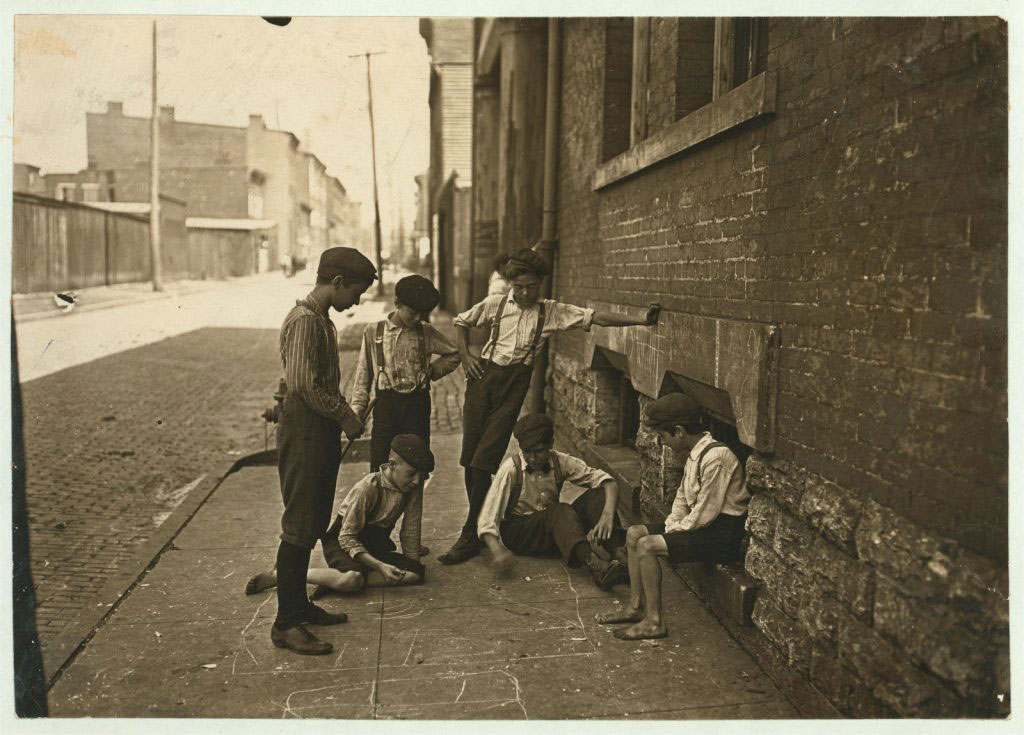
He was the first of seven children born to poor Russian-Jewish immigrants during a time when anti-Semitism was rampant. He experienced cruelty and deprivation throughout his childhood. His parents were
by all accounts […] cold, insensitive, and even cruel. His father was a heavy drinker prone to making cutting remarks about his oldest son’s looks and intelligence […] deeming him “ugly.” 1
His mother was a brutal woman he found physically and morally repugnant. Once when he brought home two abandoned kittens and she caught him offering them milk, “she grabbed the kittens and smashed their heads against a wall until they died.” Many other similar incidents occurred during his childhood. 2
Besides such cruelties at home, he also struggled with violence at school, which further complicated and made his life miserable. He had no friends, and was in constant danger from anti-Semitic gangs who hunted and beat Jewish children when they found them. 3 Lacking other resources, he discovered the public library and took refuge in books that expanded his knowledge and understanding of human nature.
He experienced the rudest of childhoods, subsisting at survival levels and in constant physical danger. After years of struggling and strife, his parents ultimately went bankrupt and divorced. He found no mentors or solace in life outside his books.
If anyone serves as an example of surviving a brutal childhood and acute societal racism, of what it means to transcend caste and class and to grow past deficiency needs to realizing his human growth potential, it is Abraham Maslow, American psychologist and founder of humanistic psychology. 4
Abraham Maslow exemplified transcending adversity, societal racism, and childhood trauma to move beyond caste and class limitations, and realize his human potential.
Maslow earned a scholarship to Cornell University, but anti-Semitism there led to his transfer to City College of New York, where he earned his BA. He next went to the University of Wisconsin to earn his MS and PhD degrees in psychology. During this time, he married his first cousin, Bertha Goodman, whom he had loved for several years. Maslow later said that their happy marriage marked the true beginning of his life.
The horrors of World War II and its aftermath inspired Maslow to wonder how people survived and grew through such traumatic ordeals. During his doctoral program and later, as a psychologist, his studies of Freud’s psychoanalytic theory led him to ask why psychologists did not study healthy, happy people and survivors rather than focusing on psychopathology.
Influenced and mentored by anthropologist Ruth Benedict and Gestalt psychologist Max Wertheimer, Maslow’s curiosity led him to develop his acclaimed hierarchy of needs, an ascent to be scaled by successive levels before arriving at the summit of self-actualization. He defined self-actualization as the full realization of one’s personal potential, achieved once basic physical, safety, and psychological needs have been met.
self actualization
This ‘self’ to which Maslow referred includes expressions of morality, spirituality, creativity, tolerance, and acceptance—in short, all the qualities taught by the world’s religions. Self-actualization may thus be regarded as the vertical relationship between the created and the creator, the individual and the universal. In analytical psychology, one might say that Maslow was talking about the transcendent function. The rare person may thus grow beyond satisfying strictly selfish needs to realizing those that transcend the self and embody a transcendent, altruistic universality.
Maslow proposed his original hierarchy of needs theory in a 1943 paper titled, “A Theory of Human Motivation,” 5 which delineated
… five sets of goals (basic needs) which are related to each other and are arranged in a hierarchy of prepotency. When the most prepotent goal is realized, the next higher need emerges. “Thus man is a perpetually wanting animal.” Thwarting, actual or imminent, of these basic needs provides a psychological threat that leads to psychopathy. 6
maslow: 5-stage hierarchy of needs (1962)

Maslow next wrote Motivation and Personality, a 1954 book discussing his theory. Maslow developed his theory after further research and wrote about it in Toward a Psychology of Being (1962), a revised Motivation and Personality (1970a), and Religions, Values, and Peak Experiences (1970b). A third edition of Motivation and Personality was published posthumously in 1987, emphasizing once more that Maslow had redefined his early five-stage model to include eight stages.
Today, most people are aware only of Maslow’s initial five-stage hierarchy, which—due to its popularity and the failures of public education—has remained trapped like an amber fossil in its earliest incarnation. Even today, many schools continue to teach the 1962 model, which is now 70 years old but has been embraced by a culture that seems bent on achieving the epitome of the American dream, namely to “be all that you can be.”
maslow: 8-stage hierarchy of needs (1970)

expressing our deficiency needs
Maslow theorized that perhaps two percent of the population would achieve self-actualization, a figure similar to that suggested by analytical psychologists. Most Americans—and perhaps most people in general—seem unable to achieve the transcendent function, appearing to idealize but express hostility toward those who do. Because many confuse religion with true spirituality, one observes religious zealots and fundamentalists who, like their secular politically polarized counterparts, believe and act on a savage intolerance that seeks to wound and even destroy the enemy—anyone who doesn’t share their beliefs or participate in their culture. Individually and collectively, people consistently fall far short of self-actualization and tend to remain stuck at lower levels of need and deficiency.
Organizational psychologist Clayton Alderfer theorized that if higher self-actualization needs are not met, people will tend to redouble their efforts at lower developmental levels. 7 Thus, for example, the person whose physiological needs are met—meaning their basic life needs for food, water, shelter and sex—will naturally move into satisfying their safety needs for security, protection, stability, etc. Such a person will grow into satisfying next level human needs for belongingness and love—family, affection, relationships. work friends, etc. If these needs are frustrated, though, the individual is likely to remain stuck, though expert at, satisfying safety needs. Such a person may over-emphasize the need for law and order in society, become a champion of rules and cultural stability, and identify strongly with others who feel similarly.
Numerous studies of religious and political zealotry and fanaticism support the idea that adherents satisfy deficiency needs through participation in fringe groups and beliefs. The inability to exercise curiosity or to tolerate other beliefs is one of several indications of the expression of deficiency needs.
A closer look at Maslow’s eight-stage model shows that esteem needs for achievement, reputation, and status likewise arise from deprivation. Other deficiency needs—physical, safety, and belongingness needs—must be met to avoid unpleasant results for the individual. Esteem deficiency needs signify that the person lacking in achievement, status, or reputation but unable to progress to higher level growth is likely to focus their efforts at satisfying current or lower needs. The American cultural obsession with individualism, status and fame, and possessions reflects our collective efforts to satisfy deficiency needs rather than a capacity to grow beyond them.
The inability to exercise curiosity or to tolerate other beliefs is one of several indications of the expression of deficiency needs.
People’s wounds aggravate their normal psychological and physical needs when they’ve been raised in deprived or diseased environments—and some argue that American culture is a culture of deprivation. In any case, to whatever extent the healthy, generous meeting of these needs is denied or hindered, the personality is similarly impoverished and the drive to satisfy deficiency needs is bound to recur. It can take a lifetime to manage whatever hand our parents and caste dealt us—so much so that growth needs may never be realized.
Even so, there is hope. Just as Maslow escaped the ignorance and cruelty of his family and caste deficiency cultures through books and education, so too may we reach past deficiency needs and grow toward the light and nourishment provided by knowledge, meaning, beauty, and fulfillment.
The main business of The Third Eve is, and has always been, to explore a spiritual mindset that assumes communication and partnership with the transcendent function of the soul. To do less is to be dragged by our own fallibility to a lower deficiency-based level. Our task as growing human beings is to continue to grow, and to invite others as companions along the way.

endnotes
- “Abraham Maslow Biography.” Explore Psychology. ↩︎
- McGrath, Michelle & The American Women’s College Psychology Department. “Chapter 23: Maslow: Holistic-Dynamic Psychology.” PSY321 Course Text: Theories of Personality. PressBooks. ↩︎
- Maddi, S. R., & Costa, P. T. Humanism in Personality: Allport, Maslow, and Murray. Transaction Publishers, 1972, p. 128. See Abstract. ↩︎
- Wilkerson, Isabel. Caste: The Origins of Our Discontents. Random House, 2023. Here, I’m drawing on Wilkerson’s definition of caste as a social hierarchy that divides people into ranked categories based on ancestry and identity. Caste systems operate similarly to racial hierarchies, but are more entrenched and rigid. In her book, Wilkerson draws comparisons between the caste systems of India, Nazi Germany, and the United States. Maslow experienced the effects of caste based on his Jewish ancestry and his class among the working poor . ↩︎
- Maslow, A. H. “A Theory of Human Motivation.” Psychological Review, (50)4, 370-396. ↩︎
- APA PsycNet Abstract. PsycINFO Database Record, 2016. ↩︎
- Kurt, Serhat. “Alderfer’s ERG Theory.” Education Library, 2023. ↩︎


Leave a Reply